

Training the next generation of accessibility and compliance specialists.
Become a Disability Rights and Accessibility Consultant

Learn how to guide organizations in meeting disability standards, improving access, and implementing practical solutions that support people of all abilities.
Register Now!




Training the next generation of accessibility and compliance specialists
Become a Disability Rights and Accessibility Consultant
Learn how to guide organizations in meeting disability standards, improving access, and implementing practical solutions that support people of all abilities.

Duration
8 Weeks
Starting
September 26, 2025
Format
100% Online
Register Now!
 US Institute Of Diplomacy And Human Rights
Disability Rights Consultant
Certified Disability Rights & Accessibility Consultant
Become a Certified Disability Rights Consultant
US Institute Of Diplomacy And Human Rights
Accessibility Consultant
US Institute Of Diplomacy And Human Rights
Disability Rights Consultant
Certified Disability Rights & Accessibility Consultant
Become a Certified Disability Rights Consultant
US Institute Of Diplomacy And Human Rights
Accessibility Consultant
The Best of the Best in 2025
COURSE OVERVIEW
In today’s world, organizations are under increasing pressure to meet accessibility standards, comply with disability laws, and create environments where people of all abilities can fully participate. What they need isn’t just more training—they need trusted consultants who understand disability rights, can communicate clearly, and provide practical, actionable guidance.
That’s where you come in
This 8-week professional training equips you with the knowledge, tools, and confidence to become a Disability Rights and Accessibility Consultant who can advise organizations, strengthen their accessibility practices, and position yourself as a recognized expert in a growing and underserved field.
You don’t need prior experience in disability law or accessibility design—just the commitment to learn, the ability to guide others, and the passion to help organizations meet their responsibilities with clarity and integrity.

MEET YOUR INSTRUCTOR
Dr. Aina G. Irbe is an award-winning learning strategist and accessibility expert with a distinguished record of transforming education and training programs for U.S. federal agencies, international NGOs, and Fortune 500 companies. Her work has strengthened major initiatives in accessible learning, digital inclusion, and equitable education design across global institutions—drawing from her experience as an Education Program Coordinator at the U.S. Department of State.
With deep expertise in instructional design and accessibility compliance, Dr. Irbe holds a Ph.D. in Educational Technology and is a Certified Professional in Accessibility Core Competencies (CPACC), one of the field’s most respected international credentials. She is also a contributing author to the International Handbook of E-Learning, where her chapter on accessible e-learning has become a widely referenced resource for educators and program designers.
Throughout her career, Dr. Irbe has built and led inclusive learning ecosystems that respect cultural diversity and ensure meaningful access for learners of all abilities. Her excellence has been recognized through top distinctions, including the U.S. Department of State’s Meritorious Honor Award and InsideNGO’s Operational Excellence Award—honors that reflect her impact on elevating accessibility standards and improving global training outcomes.
Today, Dr. Irbe is regarded as a leading voice in universal design, disability inclusion, and accessible education. She brings unmatched expertise to the preparation of future Disability Rights and Accessibility Consultants committed to promoting dignity, access, and opportunity for all.
Dr. Aina G. Irbe
Welcome and Introduction to the Course

Duration: 0.5 hour
Content delivery formats: Online text
Welcome message
What to Expect in the course
Intro to USIDHR
Goals of Course
Course Learning Objectives for Certified Disability Rights and Accessibility Consultant Training Program
Upon completion of this certification program, you will be able to

Foundation Knowledge
Articulate key principles of international disability rights frameworks (CRPD, ADA, WCAG) and apply them to organizational policies and practices

Accessibility Awareness
Identify the components of the accessibility landscape and understand when to refer organizations to qualified accessibility professionals

Professional Communication
Facilitate respectful disability awareness conversations and navigate challenging scenarios including resistance, misconceptions, and microaggressions

Consulting Practice
Define clear scope boundaries, and apply ethical guidelines for disability rights and accessibility consulting

Training Knowledge
Identify the key principles and components needed to develop disability rights and accessibility training content for diverse audiences

Technology Awareness
Identify assistive technologies and emerging accessibility solutions
By achieving these learning objectives, you will be well-prepared to obtain their Disability Rights Consultant Certification and effectively contribute to promoting and protecting disability rights.
The Disability Rights landscape
Student Roadmap
Course Materials and Resources
Course Accessibility Statement
USIDHR is committed to ensuring this certification is accessible to all participants. We recognize that as future disability rights consultants, you should experience inclusive design firsthand
Built-in Accessibility Features:
All video content includes accurate captions and full transcripts
Course materials available in Word, PDF, and HTML formats
Self-paced structure accommodates diverse learning styles and needs
Platform meets WCAG 2.1 Level AA standards
Text alternatives provided for all images and graphics
Requesting Additional Accommodations:
If you need accommodations beyond these built-in features, please contact [name/email] before starting the course. We will work collaboratively to identify effective solutions.
We treat all accommodation requests confidentially and do not require disclosure of specific diagnoses.
Disability Rights and the Disability Rights Consultant
In Module 1, you’ll develop the knowledge and skills needed to navigate the disability rights landscape and provide expert consulting to organizations.
CERTIFICATE OF COMPLETION
Upon successful completion, you will receive a professional certification signed by Dr. Aina G. Irbe, recognized internationally and ideal for your LinkedIn, resume, or consulting portfolio.
Duration: 1 hour
Content delivery formats: Video, downloadable documents, links to websites, quiz

Upon completion, you should be able to:
Explain disability rights
Define accessibility
Define the role and scope of a disability rights and accessibility consultant
Distinguish between consultant services and specialist services
Identify typical consultant deliverables and service areas
Explain professional boundaries and ethical considerations in disability rights consulting

What are disability rights and what is accessibility?
Disability rights refer to the legal protections and civil rights that ensure people with disabilities can participate fully in society without discrimination.
Accessibility is about designing physical and digital environments, products, services, and information so that people with disabilities can use them independently and effectively.
Reasonable accommodations can be requested as modifications or adjustments to a work environment, educational setting, or other context that enable a person with a disability to have equal access and opportunity to participate, perform essential functions, and enjoy the same benefits and privileges as people without disabilities.
Presenter introductions
Your role as a Disability Rights Consultant

Core Functions
Providing disability rights education and training
Reviewing policies for inclusive language and practices
Advising on disability inclusion strategies
Facilitating awareness and culture change
Identifying when specialized expertise is needed

Examples of Consultant Deliverables
Disability awareness training programs
Policy and procedure reviews with recommendations
Inclusive language guides
Disability inclusion strategic plans
Executive briefings on disability rights
Workshop facilitation
Organizational culture assessments

Distinguishing Your Role: What Sets You Apart Disability Rights Consultant
Educational focus
Strategic guidance
Awareness building
Policy advisory
Culture change facilitation
Other roles outside the disability rights consultant scope

Legal Counsel
Legal advice and representation
Compliance determination
Litigation support
Contract review
Regulatory interpretation

Accessibility Specialist
Technical audits and testing
WCAG compliance verification
Remediation implementation
Code-level fixes
Accessibility certification

Medical Professional
Diagnosis
Treatment plans
Medical accommodations determination
Disability documentation

Advocate
Individual case representation
Legal proceedings support
Benefits navigation
Case management

Assistive Technology Specialist
AT assessment and prescription
Device configuration and training
Technical support
Customization services

What Disability Rights Consultants DO:
Educate on disability rights principles and frameworks
Explain the business case for disability inclusion
Review organizational policies for inclusive practices
Provide strategic guidance on culture change
Train staff on disability awareness and etiquette
Identify accessibility barriers (awareness level)
Recommend when to seek specialist help
Facilitate disability inclusion discussions
Advise on best practices and industry trends

What Disability Rights Consultants DO NOT Provide:
Legal advice or compliance determinations
Accessibility testing or technical audits
Medical advice or disability diagnosis
Individual case management or advocacy
Assistive technology configuration
Guaranteed legal compliance certification
Technical implementation services

Introduction to Ethical Considerations: Why Ethics Matter
As a disability rights consultant, you hold a position of trust. Your ethical obligation is to disability rights and the disability community first, even when that creates tension with client preferences
Assessment: Quiz 1
Disability Rights are Human Rights
Duration: 3 hour
Content delivery formats: Video
downloadable documents
Links to websites
Quiz Forum discussion
Upon completion, you should be able to:
Explain the principles of the Universal Declaration of Human Rights (UDHR)
Articulate the key principles of the CRPD and how they apply to organizational policies and practices
Translate human rights frameworks into business language appropriate for different organizational audiences
Identify when disability rights questions require legal counsel versus educational consultation

Introduction
Now that you understand your role as a consultant, we'll establish the human rights foundation for this work. In Module 3, we'll explore specific disability types and models. But first, we need to ground ourselves in the rights-based framework that should guide all our consulting—the international human rights system and specifically the CRPD.

Human Rights Framework
Universal Declaration of Human Rights (UDHR)
Core principles: dignity, equality, non-discrimination, freedom

Disability Rights Specifics
United Nations (UN) Convention on the Rights of Persons with Disabilities (CRPD).
The UN CRPD in comparison to other human rights treaties

Mapping the CRPD to the UDHR
Overview
Handout
How to explain CRPD principles to organizational leaders in business language
Translating CRPD Principles to Business Language
Common client questions about human rights and disability rights compliance and appropriate responses

Consulting and Business Application - Human Rights & Disability Rights Foundations
Aren’t disability rights just about following the law?
How do we know if our policies align with these principles?
Red flags that legal counsel is needed instead of disability rights education
Why should we care about international frameworks like CRPD

Framework for Rights-Based Policy Review
When reviewing organizational policies, consultants should ask:
The Dignity Test:
Does this policy assume people with disabilities are capable and valued contributors?
Is language respectful and person-centered?
Are people with disabilities portrayed as active participants or passive recipients?

The Barrier Removal Test:
Does the policy focus on removing environmental barriers versus treating disability as a problem to fix?
Are accessibility features built into processes from the start?
Does the policy place burden of access on the organization, not the individual?

The Accommodation Test:
Is accommodation framed as enabling equal participation versus "special treatment"?
Is the process described as collaborative and interactive?
Are accommodations positioned as normal business practice?

The Rights and Autonomy Test:
Does language emphasize rights and dignity versus charity or pity?
Do policies respect individual choice and self-determination?
Are people with disabilities involved in decisions affecting them?
The Inclusion Test:
Are multiple disability experiences considered (not just physical disabilities)?
Does the policy address visible and invisible disabilities?
Are intersectionality considerations present?
Can you explain why accommodation is important for employee retention?
Within scope (education and business case)
Are we ADA compliant if we implement this policy?
Requires legal counsel (compliance determination)
How do other companies in our industry approach disability inclusion?
Within scope (best practices and benchmarking)
We have an EEOC complaint—can you review what happened?
Within scope (education and skill-building)
What's the minimum accessible parking we're legally required to provide?
Requires legal counsel/accessibility specialist (specific legal requirement)
Why should we invest in accessibility beyond legal minimums?
Within scope (strategic guidance and business case)
Translating CRPD to Business Policy
A mid-size tech company is revising their employee handbook. They currently have a brief paragraph that says: "The company complies with applicable disability laws. Employees needing accommodations should contact HR.
Assessment: Quiz 2
Interactive Discussion 1 in Forum: Translating Rights to Reality
Now that you've completed Module 2: Disability Rights are Human Rights, it's time to practice translating international frameworks into practical organizational guidance. This discussion helps you develop skills in making human rights principles accessible and actionable for business clients.
Instructions:
Review the Key Concepts:
Recall how to translate CRPD principles into business language
Consider how to explain the strategic value of rights-based approaches
Remember the distinction between educational consultation and legal advice
Engage in the Translation Challenge:
Review the scenarios below
Choose one scenario and craft your consultant response
Demonstrate how you'd translate human rights principles into business-relevant guidance
Read at least two peer responses to different scenarios
Provide constructive feedback such as:
How effectively they translated rights language to business language
o Whether they maintained appropriate scope boundaries
o Suggestions for strengthening their business case
Alternative approaches they might consider
Scenario 1: The Skeptical Executive
You're meeting with a CEO who says: "I've been asked to care about the UN Convention on disability rights. We're a small regional company in [your location]. Why should I care about an international treaty? We just need to follow local employment laws. Isn't this just more bureaucracy and political correctness?"
Your Task: Draft your response that:
Acknowledges their practical concerns
Translates CRPD relevance into business terms
Distinguishes between legal compliance and strategic advantage
Avoids sounding preachy or theoretical
Scenario 2: The Policy Revision Request
An HR Director sends you their company's disability policy (shown below) and asks: "Can you tell us if this is good enough? We want to be inclusive but also legally protected."
Current Policy: "Employees who have disabilities or special needs may request accommodations by submitting Form HR-42 along with medical documentation proving their condition substantially limits a major life activity. Requests will be reviewed on a case-by-case basis. The company will provide accommodations when reasonable and when they do not create undue hardship."
Your Task: Provide:
What requires legal counsel input
uggested language improvements you can make
How you'd explain the strategic value of changes
What's problematic from a rights-based perspective
What's within your scope vs. what needs specialist input
Scenario 3: The We Already Comply Company
A company contacts you saying: "We've passed our last three accessibility audits and haven't had any discrimination complaints. We're legally compliant. Why would we need disability rights consulting?"
Your Task: Craft your response that:
Distinguishes between compliance and inclusion
Explains the business case for going beyond minimum legal requirements
Uses CRPD principles without overwhelming them with treaty language
Provides concrete examples of value you could add
Why This Matters:
Your ability to translate human rights frameworks into accessible, business-relevant language determines your effectiveness as a consultant. Clients rarely care about treaty articles—they care about business outcomes, risk management, and competitive advantage. Your skill is making the connection between rights-based principles and organizational success.
The Disability Landscape
In Module 3, you’ll master the global disability landscape: understand disability types, prevalence, and demographics; distinguish between medical, charity, social, and rights-based models
CERTIFICATE OF COMPLETION
Upon successful completion, you will receive a professional certification signed by Dr. Aina G. Irbe recognized internationally and ideal for your LinkedIn, resume, or consulting portfolio.
Duration: 3 hours
Content delivery formats: Video, links to websites, quiz, forum discussion

Module Enabling Learning Objectives
Upon completion, you should be able to:
Distinguish between medical, charity, social, and rights-based disability models
Define the current global landscape of disability types, prevalence, and demographics
Explain how to address common misconceptions about disability using evidence-based corrections
Identify intersectionality factors that impact and incorporate inclusive approaches in consulting work

Disability Types & Statistics
Visual impairments (with experiential exercise)
Hearing and speech impairments (with experiential exercises)
Mobility impairments (with experiential exercise)
Cognitive and learning disabilities (with examples)
Multiple, temporary, and invisible disabilities with examples)

Disability Models and Analysis
Medical model
Charity model
Social model
Rights-based model
Comparison and implications

Addressing Misconceptions
Common myths and stereotypes
Evidence-based corrections
Strategies for education and awareness

Consulting and Business Application – The Disability Landscape
How to present disability statistics meaningfully to different audiences (HR, executives, educators)
Presenting Disability Statistics to Different Audiences
For HR Teams
For Executives
For Educators
For Marketing/Product Teams

Addressing client misconceptions professionally using evidence-based corrections
Misconception: Disability accommodations are expensive
Misconception: We don't have any disabled employees
Misconception: Accessibility is just wheelchair ramps
Incorporating intersectionality considerations into organizational assessments

When assessing organizational disability inclusion, consider
Disability + Race/Ethnicity
Disability and Religion
Disability + Gender
Disability + Age
Disability + LGBTQ+ Identity
Disability + Socioeconomic Status
Application Example
When reviewing this company's disability inclusion initiative, I noticed their disability employee resource group was planning events. I asked about accessibility across dimensions—would events be financially accessible? In multiple languages? Welcoming to family members? This prompted them to redesign with intersectionality in mind.
Identifying which disability model thinking is influencing organizational policies

Medical Model Indicators
Focus on diagnosis and medical documentation
Accommodation framed as medical necessity
Emphasis on "fixing" or "overcoming" disability
Charitable or pitying language
Segregated programs or services

Charity Model Indicators
Language of helping or supporting
Emphasis on inspiration or courage
Volunteer or charity-focused initiatives
Patronizing tone
Focus on what organization does "for" people with disabilities

Social Model Indicators
Focus on removing environmental barriers
Emphasis on changing systems, not people
Recognition that disability is created by inaccessible design
Problem-solving language
Collaboration language

Rights-Based Model Indicators
Language of rights, dignity, and equality
Focus on participation and inclusion
Universal design approaches
Empowerment and self-determination language
Disability as diversity/identity
Case Study Examples

Interactive Discussion 2 in Forum
Now that you've completed Module 3: The Disability Landscape, it's time to apply your understanding of disability, disability models and intersectionality to real-world scenarios. This discussion will help you analyze how different organizational approaches reflect underlying beliefs about disability and identify opportunities for disability rights-based consulting.

Instructions:
Review the Key Concepts
Reflect on the medical, charity, social, and rights-based disability models
Consider how intersectionality factors impact disability experiences
Think about how to present disability statistics meaningfully to different audiences

Engage in the Case Study Discussion
Review the three case studies presented in Module 3 (TBD)
Choose one case study and analyze it using the frameworks you've learned
Share your insights in the forum
Read at least two peer responses to different scenarios

Reply with constructive insights, such as
Additional intersectionality considerations they might have missed
Alternative approaches to model identification
Cultural or regional factors that might apply

For your chosen case study, address these questions:
Model Identification: Which disability model(s) do you see reflected in this organization's approach? What specific language or practices reveal this?
Intersectionality Considerations: What intersectionality factors are present or missing in this case? How might the consultant address these?
Consultant Role: What specific services did the consultant provide that stayed within appropriate scope? Were there any moments where referral to specialists might have been needed?
Practical Application: If you were consulting with a similar organization in your region, what would you adapt based on local context, laws, or cultural factors?

Why This Matters
As a disability rights consultant, you'll need to quickly assess organizational approaches and identify which disability model thinking influences their policies. This skill helps you tailor your consulting approach and make strategic recommendations for rights-based improvements.
Assessment: Quiz 3
The Accessibility Landscape
Duration: 3 hours
Content delivery formats: Video
downloadable documents
Links to websites
Quiz Forum discussion

Upon completion, you should be able to:
Identify accessibility barriers across physical, digital, communication, and educational environments
Interpret key provisions of global, national,, and other relevant accessibility standards for consulting purposes
Determine when to refer organizations or people to qualified professionals
Articulate the business case for accessibility using ROI metrics and legal compliance requirements

The Accessibility Landscape Trifecta
People, legal frameworks, technologies
The interconnected relationship

Universal Application
Physical accessibility
Digital accessibility
Educational accessibility
Communication accessibility
Reasonable Accommodations
People
People with disabilities
Accessibility professionals

Laws and Guidelines
International
Web Content Accessibility Guidelines (WCAG)
Universal Design for Learning (UDL)
Why should we care about international frameworks like CRPD

Canada
Accessibility Standards Canada
Accessibility for Ontarians with Disabilities Act (AODA)

Europe
European Accessibility Act
The African Disability Protocol (ADP)

United States
Americans with Disabilities Act (ADA)
The Rehabilitation Act
Section 508
Section 501
Section 54
Section 255 of the Communications Act

Other
21st Century Communications and Video Accessibility Act (CVAA)
Air Carrier Access Act (ACAA)

The economic and business impact
The economic and business impact

Consulting and Business Application – The Accessibility Landscape
When to reference international frameworks vs. local/national laws in consulting conversations
Use International Frameworks (WCAG, CRPD, UDL) when:
Client has global operations or audience
Discussing best practices beyond minimum compliance
Client wants to lead industry vs. follow
Developing forward-looking strategy
Local laws are unclear or emerging
Use Local/National Laws (ADA, Section 508, etc.) when
Client asks about specific legal requirements
Discussing compliance baselines
Working with government contractors
Immediate legal concerns exist
Client operates in single jurisdiction

Explaining the business case for accessibility without overstating ROI claims
Market Access (Verifiable
Legal Risk Management (Clear)
Innovation Benefits (Demonstrated)
Talent Benefits (Supported)
AVOID Overstating:
Don't claim: Accessibility will increase revenue by X%
Don't promise: ROI of $Y for every $1 spent
Don't guarantee: This will definitely prevent lawsuits

When to refer clients to accessibility professionals vs. continuing consultation
Decision flowchart (to be created)

How to help organizations prioritize accessibility improvements within their scope
Teach clients to be aware and ask:
Impact: How many people are affected?
Severity: How significant is the barrier?
Effort: What's required to address it?
Risk: What's the legal/reputational exposure?

Distinguishing between compliance questions (refer to legal) and awareness education
Compliance Questions (Refer to Legal):
Are we ADA/Section 508 compliant?
What are we legally required to do?
Could we be sued for this?
What's our legal exposure?
Do we have to provide X accommodation?
What does the law specifically require?

Awareness/Education Questions (Within Consultant Scope)
Why does accessibility matter?
How do we build an accessibility-minded culture?
What does accessibility mean for our industry?
How do we talk about accessibility with our team?
What are accessibility best practices?
"How do we make accessibility part of our process?

Gray Area (May Need Both
How do we develop an accessibility policy?
Consultant: Provide policy examples, best practices, strategic guidance
Legal: Review final policy for legal compliance
What accommodations should we offer?
Consultant: Explain accommodation principles, process best practices
Legal/HR: Determine specific legal obligations
Medical: Assess individual needs
Assessment: Quiz 4
Interactive Discussion 3 in Forum:
You've now explored Module 4: The Accessibility Landscape of people and laws. This discussion challenges you to navigate the boundaries between consultant education and specialist referral using realistic workplace scenarios.
Instructions:
Review the Key Concepts:
Recall when to reference international frameworks versus local laws
Consider the business case components for accessibility
Remember the distinction between compliance questions and awareness education
Engage in the Boundary Navigation Discussion:
Below are three scenarios where clients ask for your guidance
Choose one scenario and craft your response
Explain your reasoning for staying in scope or making referrals
Read at least two peer responses to different scenarios
Offer feedback on their boundary-setting and suggest refinements
Scenario 1: The Website Redesign
A client emails: "We're redesigning our website and want to make sure it's accessible. Can you review our wireframes and tell us if we're ADA compliant? We'd also like you to test the site once it launches to certify it's accessible
Scenario 2: The Policy Question
During a training session, the HR Director asks: "Our employee handbook says we provide 'reasonable accommodations as required by law.' What exactly are we legally required to provide? Can we set a budget cap on accommodations?"
Scenario 3: The Global Expansion
A multinational company asks: "We're expanding to Canada, the EU, and Kenya. Can you tell us what accessibility laws we need to comply with in each region and help us ensure legal compliance?"
Why This Matters:
Maintaining appropriate scope boundaries protects both you and your clients. Learning to recognize when questions shift from education to legal/technical advice is essential for ethical consulting practice.
Why Become a Disability Rights and Accessibility Consultant?

Demand is rising worldwide
Organizations across the globe—businesses, government agencies, schools, NGOs, and international institutions—are being required to improve accessibility, meet disability standards, and create environments that allow people of all abilities to participate fully. Most lack the internal expertise to do this effectively.

Your skills fill a critical gap
Disability rights and accessibility knowledge is still limited inside many organizations. Consultants who understand global accessibility frameworks, rights-based principles, and practical implementation strategies are urgently needed to guide leaders, improve systems, and prevent compliance failures.

No legal or technical background required
You will be guided step-by-step through the essential principles of disability rights, accessibility standards, and practical implementation. The training uses clear, accessible language and real-world tools—no prior experience in disability law or accessibility design needed.

You’ll gain global professional credibility
Upon completion, you earn a recognized international certification that demonstrates your expertise and prepares you to advise organizations anywhere in the world. You’ll enter the field with confidence, practical frameworks, and the authority to support meaningful accessibility change across sectors.
Assistive Technology & Emerging Technologies
In Module 5, you’ll explore cutting-edge assistive and emerging technologies: understand the range of assistive tools and devices, learn how to evaluate and implement them effectively, and discover how innovative technologies are shaping accessibility solutions for diverse needs.
CERTIFICATE OF COMPLETION
Upon successful completion, you will receive a professional certification signed by Dr. Aina G. Irbe recognized internationally and ideal for your LinkedIn, resume, or consulting portfolio.
Duration: 3 hours
Content delivery formats: Video, links to websites, quiz, forum discussion

Module Enabling Learning Objectives
Upon completion, you should be able to:
Define assistive technologies and explain their role in accessibility at an awareness level
Identify built-in accessibility features in common business tools
Explain AI's potential benefits and current limitations for disability inclusion
Determine when clients need AT specialists versus general awareness education

What Consultants Need to Know
As a disability rights consultant, you don't need to be an AT or technology expert—you need strategic awareness. Your role is to:
Explain what AT and technologies exist and why it matters
Help organizations understand AT and technologies in business context
Know when to refer to specialists
Core Assistive Technologies
Definition
Assistive Technology (AT) includes any device, software, or equipment that helps people with disabilities perform tasks, improve capabilities, or increase independence.
Overview of assistive technologies
Physical
Mobility devices (wheelchairs, walkers, canes, prosthetics)
Hearing aids and assistive listening devices
Service animals
Adaptive keyboards and alternative input devices
Braille displays and note-takers

Digital
Screen readers (software that reads digital content aloud)
Screen magnification software
Voice recognition/speech-to-text software
Text-to-speech applications
Closed captioning and live transcription (CART) (note that AI generated
Alternative keyboards and switches

Why This Matters for Consultants
Organizations need to understand that accessibility isn't about accommodating one specific technology—it's about creating environments and content that work with the diverse range of tools people use.

Accessibility Tools: Quick Awareness
What Consultants Should Know:
Many common business tools have built-in accessibility checkers that provide preliminary feedback. These are useful starting points but don't replace professional accessibility audits.
Color contrast checkers
Web based automation

Microsoft Office Products
Word, PowerPoint, Excel: Accessibility Checker (Review tab → Check Accessibility)
Identifies issues like: missing alt text, low color contrast, heading structure problems, unclear link text
Provides guidance on how to fix issues

Adobe Acrobat
Built-in accessibility checker for PDFs
Can check reading order, tags, color contrast
Note: Creating accessible PDFs from the start is better than remediating later
Note: Automated testing never catches all accessibility failures. Manual testing must be conducted in tandem with any automation.

AI Accessibility
Document Accessibility
AI-powered accessibility checkers for preliminary content review
Automated alt text generation (with human review)
Color contrast analyzers
Use case: Quick policy document review before recommending formal audit

Translation and Multilingual Support
AI translation for creating multilingual accessibility content
Cultural context guidance
Use case: Developing inclusive materials for diverse workforces

Research and Current Awareness
AI research synthesis tools
Legal and policy update monitoring
Trend analysis
Use case: Staying current on accessibility developments

Content Creation
AI-assisted policy drafting (with human expertise and review)
Training material development
Presentation creation
Use case: Efficiently creating customized client materials
Meeting and Communication Support
Real-time transcription for accessible meetings
Meeting summary generation
Note-taking assistance
Use case: Creating accessible records of client consultations

IMPORTANT CONSULTANT NOTE
I use these AI tools to work more efficiently and create better resources for clients. But I always emphasize: AI is a support tool, not a replacement for human expertise, accessibility audits, or user testing. When I recommend AI tools to clients, I stress the same—use them appropriately within a comprehensive accessibility strategy."

IMPORTANT NOTE
AI can marginalize groups, like people with disabilities based on the data that has been entered. Always review AI output.

Consulting and Business Application – Assistive Technology & Technical Solutions
How to discuss assistive technology with clients without providing technical support
Your Role as Consultant

DO
Raise awareness that AT exists and helps
Explain why AT access matters for inclusion
Help organizations understand AT in business context
Identify when AT specialists are needed

DON’T
Configure or troubleshoot specific AT
Recommend specific AT products for individuals
Provide technical training on AT use

Provide sample scripts and examples for the Dos and DON’Ts
Identifying when organizations need AT specialists vs. awareness education
Common misconceptions about assistive technology costs and complexity
Misconceptions:
Assistive technology is expensive
AT is too complicated for our team to support
We need to provide AT for employees
Only blind people use AT
Evidence-Based Correction example

Interactive Discussion 4 in Forum
After completing Module 5: Assistive Technology & Emerging Technologies, you understand the importance of AT and emerging technology awareness without providing technical support. This discussion focuses on having productive conversations about assistive technology and AI within your consultant role.

Instructions:
Review the Key Concepts
Remember the distinction between AT awareness and AT technical support
Recall common misconceptions about AT costs and complexity
Consider when AT specialists are needed versus awareness education

Engage in the AT Conversation Discussion:
Review the scenarios below involving assistive technology
Choose one scenario and describe how you would handle the conversation
Focus on educating while respecting boundaries:
How you address the immediate concern
What education you provide within scope
What referrals you make and why
Any resources or frameworks you'd offer
Read at least two peer responses to different scenarios
Comment on their approach to balancing helpfulness with boundaries

Experience and Reflect
Navigate favorite website using only keyboard
Use mobile screen reader (VoiceOver/TalkBack)
Share your own user experience insights What surprised you? What was frustrating?

Scenario 1: The Manager's Concern
A manager says: I have an employee who's blind starting next week. I need to know what assistive technology to buy for them and how to set it up before they arrive. Can you recommend specific screen readers and come install them?

Scenario 2: The Budget Objection
During an executive briefing, the CFO interrupts: You keep talking about assistive technology, but I've heard it's incredibly expensive. We can't afford to buy specialized equipment for every employee who might need it. Isn't this going to cost us hundreds of thousands of dollars?

Scenario 3: The IT Troubleshooting Request
A client contacts you: Remember that employee you trained us about? Their screen reader stopped working with our new software update. Can you come fix it? Our IT department doesn't know anything about accessibility.

Why This Matters
Clients often don't understand the difference between AT awareness and AT technical services. Your ability to educate about AT while appropriately referring technical needs demonstrates professional competence and protects you from liability.
Assessment: Quiz 5
Professional Communication & Etiquette
Duration: 3 hours
Content delivery formats: Video
downloadable documents
Links to websites
quiz forum discussion

Upon completion, you should be able to:
Explain respectful disability awareness conversations using person-first or identity-first language as appropriate
Describe how to apply professional communication protocols for different disability types
Explain how to avoid common mistakes and microaggressions in disability-related interactions

Language & Communication
Person-first and identity-first language preferences
Eliminating outdated and offensive terminology
Professional communication protocols

Interaction Guidelines
Physical interaction etiquette (based on person and disability)
Communication accommodations by disability type
Service animal protocols
Professional workplace considerations

What NOT to Do
Common mistakes and microaggressions
Privacy and personal boundary respect

Consulting and Business Application – Professional Communication & Etiquette
Modeling appropriate disability etiquette during client interactions
Before Meetings
During Meetings
After Meetings
Modeling Language
Handling situations where clients use inappropriate language or concepts
How to correct client language respectfully during meetings

THE CEO Correction Scenario
Situation: During a meeting, a senior leader uses outdated or inappropriate disability terminology (e.g., "wheelchair bound," "suffers from," "handicapped," "special needs").
Immediate Response (In the Meeting)
Option 1 - Gentle Real-time Correction
I appreciate what you're sharing. Just a quick note on language we typically say 'wheelchair user' rather than 'wheelchair bound,' as it's more empowering. But I understand your point about [return to their content]...
Why this works:
Acknowledges their contribution first
Brief, non-judgmental correction
Provides the correct alternative
Immediately returns to business discussion
Doesn't derail the meeting
Option 2 - Positive Reframing
That's an important point. When we talk about people with disabilities [uses correct language to model], we see that [builds on their idea]...
Why this works:
Models correct language without calling out the error
Keeps conversation moving forward
Educates through example
Non-confrontational

Option 3 - Bridge to Education
I want to pause on language for just a moment, because it connects to what we're discussing. The language we use shapes how we think about disability. For example, saying 'uses a wheelchair' instead of 'wheelchair bound' emphasizes mobility and independence rather than limitation. This matters because [connect to meeting topic].
Why this works:
Frames language as strategic, not just "politically correct
Connects to business objectives
Educates while respecting their time
Positions you as expert without being condescending

WHAT NOT TO DO
That's offensive" or "You can't say that"
Lengthy lecture that derails the meeting
Embarrassing them in front of others
Ignoring it completely (missed educational opportunity)
Well, actually..." tone

FOLLOW-UP (After the Meeting):
Option 1 - Private Email/Conversation
Thank you for the productive meeting today. I wanted to follow up on the language discussion. I know disability terminology has evolved significantly, and it can be challenging to stay current. I've attached a quick reference guide on inclusive language that many of my clients find helpful. The key principle is that language should emphasize dignity, capability, and person-first or identity-first preferences. Happy to discuss further if useful!

Option 2 - Resource Sharing
Following up on our meeting—I thought you might appreciate this one-page guide on disability language. It's not about being 'politically correct' but about accurate, respectful communication that supports the inclusive culture you're building. A few quick updates: [2-3 specific examples relevant to their context].

Option 3 - Offer Training
I noticed some questions about disability language came up in our meeting. This is something many leaders navigate—terminology has evolved considerably. Would it be valuable for me to do a brief session with your leadership team on inclusive language? I can tailor it to your industry and keep it practical and actionable.

Adapting communication style for different organizational cultures
For Formal/Hierarchical Organizations
For Casual/Flat Organizations
For Defensive/Resistant Leaders
For Receptive/Learning-Oriented Leaders
Handling Pushback
Examples will provide scripts on how to respond)
This is just political correctness gone too far
I have a disabled family member and they don't care about this
We have more important things to focus on than word choice
I can't keep up with all these changes
Assessment: Quiz 6
Interactive Discussion 5 in Forum:
(sample responses will be added and/or integrated in scenario and task)
Now that you've completed Module 6: Professional Communication & Etiquette, it's time to practice responding to challenging language and communication situations you'll encounter as a consultant. This discussion helps you develop diplomatic correction skills.
Instructions:
Review the Key Concepts:
Recall strategies for correcting inappropriate language respectfully
Remember person-first versus identity-first language preferences
Consider how to adapt communication for different organizational cultures
Engage in the Communication Challenge Discussion:
Below are three scenarios where clients ask for your guidance
Review the scenarios below involving problematic language or concepts
Consider organizational culture in crafting your response
Choose one scenario and describe both your in-the-moment response and follow-up approach
Discuss:
Your in-the-moment response
Your follow-up approach after the meeting
Brief explanation of your strategy and cultural considerations
Read at least two peer responses to different scenarios
Offer suggestions for refining their diplomatic approach or handling potential pushback
Scenario 1: The CEO's Language
During a meeting with senior leadership about disability inclusion, the CEO enthusiastically says: "We want to feature our wheelchair-bound employee in our annual report. Her story of overcoming her disability despite being confined to a wheelchair is so inspiring. She's proof that disabled people can be just as productive when they try hard enough.
Scenario 2: The Inspiration Event
An HR Director contacts you: "We're planning a disability awareness week! We want to do wheelchair basketball and blindfold activities so employees can experience what it's like to be disabled. We'll also bring in an inspirational speaker who overcame their disability. Can you help us plan this?"
Scenario 3: The Defensive Pushback
After you suggest changing "handicapped parking" to "accessible parking" in company materials, a manager responds: "This political correctness is getting ridiculous. My uncle is disabled and he doesn't care what we call things. We have more important business priorities than policing everyone's language. Why are we wasting time on this?
Scenario 4: Client makes ability-based assumptions
Obviously we can't hire someone with that disability for this role.
Scenario 5: Client resists accessibility investment
Accessibility is expensive and only helps a small number of people
Scenario 6: Client excludes disabled people from planning
We're creating our disability inclusion program. We'll bring in disabled employees once we have it ready."
Why This Matters
How you handle problematic language and concepts directly impacts your effectiveness as a consultant. Developing skills to educate without alienating clients ensures you can create lasting change rather than one-time corrections.
Examples and Practice Scenarios
In Module 7, you’ll apply your knowledge through real-world examples and practice scenarios: analyze case studies, explore practical solutions, practice decision-making, and develop hands-on skills to confidently address accessibility challenges and assist organizations in implementing effective disability-inclusive strategies.
CERTIFICATE OF COMPLETION
Upon successful completion, you will receive a professional certification signed by Dr. Aina G. Irbe recognized internationally and ideal for your LinkedIn, resume, or consulting portfolio.
Duration: 2 hours
Content delivery formats: Videos, printouts of scenarios, forum discussion

Module Enabling Learning Objectives
Upon completion, you should be able to:
Navigate consulting specific scenarios including resistance to accessibility solutions with evidence-based responses
Using the provided scenarios, reflect on problem-solving approaches for disability-related issues

Real-World Consulting Scenarios
Instructions
Reflection Questions for Each Scenario:
For consultant self-assessment:
What is within my scope in this situation?
What requires referral to specialists?
What are the immediate and long-term educational opportunities?
How do I balance being helpful with maintaining boundaries?
What business case/evidence can I provide?
How do I adapt my response to this organizational culture?
What follow-up actions should I recommend?
How do I document my recommendations?

SCENARIO 1: The Resistant HR Director
Situation: You're consulting with a mid-size company. During a training session on reasonable accommodations, the HR Director says privately: This is all well and good, but honestly, accommodations are a huge burden. Every time someone requests something, it disrupts our whole workflow. I wish people would just tell us about their disabilities when we hire them so we can avoid this.

Questions for Analysis
What are the multiple issues in this statement?
What is within your scope to address?
What requires referral?
How do you respond in the moment?
What follow-up is needed?

Key Learning Points
Distinguish legal issues (hiring practices) from education opportunities (reframing accommodations)
Address the emotional frustration while correcting misconceptions
Provide practical solutions within scope
Make appropriate referrals

SCENARIO 2: The Policy Review Challenge
Situation: A client asks you to review their employee handbook. You find multiple problematic elements:
Refers to "handicapped parking" throughout
Accommodation section uses "special needs" language
States employees must provide medical documentation "proving" disability
Includes phrase "qualified individuals who happen to have disabilities
No mention of service animals, only "pets are prohibited"
Questions for Analysis
What language issues do you identify?
What policy issues need legal review?
How do you prioritize your feedback?
What's your deliverable to the client?
Key Learning Points
Distinguish language updates (within scope) from legal review needs (referral)
Provide organized, actionable feedback
Offer to support implementation while respecting boundaries
Frame recommendations constructively

SCENARIO 3: The Budget-Constrained Accessibility Implementation
Situation: You're working with a nonprofit that wants to improve accessibility but has a very limited budget. The Executive Director says: "We want to do the right thing, but we can barely afford our basic operations. We can't afford expensive accessibility consultants or major renovations. Should we just wait until we have more funding?"
Questions for Analysis
What assumptions are embedded in this statement?
What low-cost/no-cost actions can you recommend?
How do you prioritize accessibility improvements?
What's your role vs. what requires specialists?
Key Learning Points
Challenge "all-or-nothing" thinking about accessibility
Provide tiered approach based on resources
Identify what's within consultant scope vs. specialist needs
Emphasize starting now rather than waiting

SCENARIO 4: The Executive Who Doesn't See the Priority
Situation: You're presenting to a company's executive team about disability inclusion. The CEO interrupts: "Look, we have three disabled employees out of 200. This affects less than 2% of our workforce. We have other diversity priorities that impact more people. Why should disability be a focus?"
Questions for Analysis
What misconceptions need addressing?
How do you make the business case quickly?
How do you respond without being defensive?
What data/examples will be most compelling for executives?
Key Learning Points
Lead with data that challenges assumptions
Connect to business priorities executives care about
Reframe from "charity" to "business strategy"
Offer to continue conversation with concrete examples

SCENARIO 5: The Accommodation Request Conflict
Situation: A manager contacts you (as consultant to their organization): "One of my employees requested a modified schedule as an accommodation for their mental health condition. I approved it, but now other team members are complaining that it's unfair—they want flexible schedules too. This accommodation is creating problems. What do I do?"
Questions for Analysis
What is within your scope to address?
What requires HR/legal involvement?
What are the teaching opportunities?
How do you support the manager without overstepping?
Key Teaching Point
When accommodations create team tension, it's usually not about the accommodation it's about overall workplace flexibility and communication. The solution isn't to eliminate accommodations; it's to address workplace culture and policies more comprehensively."
Key Learning Points
Immediately identify HR/legal boundary issues
Separate individual situation (HR) from systemic opportunity (consultant)
Provide education without giving legal advice
Use situation as entry point for broader culture work

SCENARIO 6: The Inaccessible Event
Situation: Your client is planning their annual company conference. They send you the draft agenda and ask for feedback. You notice: all-day agenda with no breaks, venue is not wheelchair accessible, no mention of captioning or ASL interpretation, registration form doesn't ask about accessibility needs, panels are all non-disabled speakers discussing "overcoming challenges."
Questions for Analysis
What are all the accessibility barriers you identify?
How do you prioritize your feedback?
What's educational guidance vs. what needs specialists?
How do you provide feedback without overwhelming the client?
Key Learning Points
Organize feedback by priority (critical vs. nice-to-have)
Distinguish must-fix from should-improve
Identify what's within scope vs. specialist needs
Provide actionable recommendations with timeline
Offer continued support for implementation

SCENARIO 7: The Technology Procurement Decision
Situation: Your client's IT department is selecting new software for company-wide use. They ask you: "We're deciding between two platforms. Can you tell us which one is more accessible? We want to make sure we're compliant."
Questions for Analysis
Is this within your scope?
What can you appropriately advise?
Who should be involved in this decision?
How do you add value without overstepping?
Key Learning Points
Clearly distinguish technical evaluation (out of scope) from process guidance (in scope)
Provide value through questions and process, not technical judgment
Make appropriate referrals
Position consultant role as complementary to specialist work

Scenario 8: The Inspiration Speaker
Client wants to book "inspirational disabled speaker" who has controversial views that contradict disability rights principles. How do you handle?

Scenario 9: The Disclosure Dilemma
HR asks you to help them convince a disabled employee to disclose their disability so they can provide accommodations. What are the issues?

Scenario 10: The Accessibility Overlay
Client installed an "accessibility overlay" widget on their website and considers accessibility "done." What do you say?

Scenario 11: The Segregated Solution
Organization wants to create separate "accessible version" of their website. Why is this problematic and what do you recommend?

Scenario 12: The Well-Meaning Microaggression
During your training, a manager says "I don't see disability, I just see people." How do you respond?

Interactive Discussion 6 in Forum
After working through Module 7: Examples and Practice Scenarios, you've analyzed multiple consulting situations. This final discussion focuses on ethical decision-making and professional judgment in ambiguous situations.

Instructions:
Review the Key Concepts
Reflect on scope boundaries and when to refer
Consider ethical principles including competency, confidentiality, and cultural responsiveness
Think about the "do no harm" principle in consulting practice

Engage in the Ethics Discussion
Review the ethical dilemmas below
Choose one dilemma and explain how you would navigate it
Consider multiple stakeholders and potential consequences
Provide:
Your analysis of the ethical considerations
Your decision and rationale
How you would prevent or prepare for similar situations
Read at least two peer responses to different scenarios

Engage thoughtfully by
Identifying ethical principles they applied well
Raising considerations they might have missed
Offering alternative perspectives respectfully

Discussion Scenarios:
Scenario 1: The Competing Interest
You're consulting with Company A on their disability inclusion strategy. Company B, a direct competitor in the same industry, contacts you for similar services. Both companies operate in a small market where your recommendations could provide competitive advantage. How do you handle this?

Scenario 2: The Insufficient Expertise
A client asks you to develop a comprehensive mental health accommodation policy for their organization. While you understand disability rights principles, you realize this requires deeper mental health expertise than you possess. However, this is a lucrative contract and the client trusts you. What do you do?

Scenario 3: The Confidentiality Question
You're consulting with an organization and discover they have significant accessibility barriers that could pose safety risks. During a conversation with another client in a different industry, they mention considering the first organization as a vendor. Do you share what you know?

Scenario 4: The Personal Values Conflict
A client's business practices conflict with your personal values regarding disability rights (e.g., they use sheltered workshops, or their marketing heavily features inspiration narratives). They've hired you specifically for your expertise. How do you approach the engagement?

Why This Matters
Ethical decision-making distinguishes professional consultants from those simply offering services. Your ability to navigate gray areas with integrity builds trust, protects vulnerable populations, and establishes your reputation as a thoughtful practitioner.
Assessment: Quiz 7
What You Will Learn
Module Summary Overview
In 8 Modules, you will master the essential disability rights, accessibility, and compliance consulting skills to confidently guide organizations and lead impactful inclusion projects.
Welcome and Introduction to the Course
Disability Rights and the Disability Rights Consultant
Define consultant role, ethics, and boundaries
Disability Rights are Human Rights
Apply CRPD and UDHR frameworks to consulting practice
The Disability Landscape
Understand disability types and models, misconceptions, and intersectionality
The Accessibility Landscape
Explain the people, laws, and factors that make up the accessibility landscape and know when to refer specialists
Assistive Technology & Emerging Technologies
Discuss AT awareness and AI applications ethically
Professional Communication & Etiquette
Model inclusive communication and correct language respectfully
Examples and Practice Scenarios
Analyze real-world consulting cases and scope boundaries
Becoming a Disability Rights Consultant
Assemble consulting toolkit and commit to ethical practice
WHAT MAKES THIS PROGRAM DIFFERENT?

Certification by USIDHR
Earn an internationally recognized certification from the US Institute of Diplomacy and Human Rights (USIDHR), a respected global leader in education, policy, and professional training.

Led by a Renowned Accessibility Expert
Learn directly from Dr. Aina G. Irbe, an award-winning accessibility strategist whose work has shaped training and compliance practices across U.S. federal agencies, international NGOs, and major global institutions.

Real-World Consulting Frameworks
No fluff or theory overload. You get practical models, templates, checklists, and case studies designed for real organizational needs and immediate application.

Post-Training Mentorship
You will retain access to the program’s materials, templates, and updates provided as part of the course so you can continue applying what you learned long after the training ends.

Lifetime Access to Training Materials
Get lifetime access to all training modules and downloadable tools, plus entry into the private community group where graduates can connect, share insights, and support one another.
Support System
USIDHR alumni network
Mentorship connections
Professional associations
Continuing education pathways

What You Can Do as a Certified Disability Rights Consultant
Defining Your Niche: While you're certified as a Disability Rights Consultant, consider where you'll focus:
Industry specialization (healthcare, tech, education, government, nonprofit)
Service specialization (training, policy review, strategic advising)
Size of organization (small business, enterprise, government)
Geographic focus (local, national, international)

Your Value Proposition: Craft a clear statement of what you offer
I help [target clients] understand disability rights and build inclusive cultures through [specific services]
Emphasize education and strategic guidance
Differentiate from technical specialists and legal counsel
Connect to business outcomes clients care about

Continuous Professional Development
Stay Current:
Monitor legal and regulatory changes
Follow disability rights organizations and thought leaders
Attend conferences and webinars
Read current research and case studies
Engage with disability community
Update knowledge of assistive technology trends

Expand Your Network
Connect with other disability rights consultants
Build referral relationships with specialists
Join professional associations
Participate in communities of practice
Mentor and be mentored
Seek Feedback
Request client feedback after engagements
Conduct periodic satisfaction surveys
Reflect on what's working and what needs improvement
Adjust approach based on learning

Ethical Practice
As a disability rights consultant, you hold a position of trust. Your ethical obligation is to disability rights and the disability community first, even when that creates tension with client preferences. This foundation guides all your professional decisions.
Core Ethical Principles
Competency and Scope Boundaries
Practice within your expertise
Do:
Educate on CRPD principles and rights-based approaches
Review policies for inclusive language
Provide guidance on accessibility best practices
Continuously develop your skills and knowledge
Don't:
Provide legal compliance determinations
Conduct technical accessibility audits outside your training
Misrepresent your expertise
Provide services beyond your capabilities
Key Practice: Be honest about your limitations and refer proactively to specialists.
Center Disability Community Voices
Apply "Nothing About Us Without Us"
Amplify disabled voices—don't speak over them
Acknowledge your own positionality
Avoid tokenizing disabled people
Practice authenticity in representing community perspectives
Rights-Based Over Compliance-Focused
Advocate for dignity and inclusion, not just legal minimums
Frame inclusion as human rights, not just legal obligation
Challenge medical model and charity model thinking
Encourage exceeding minimum standards
Connect rights to business outcomes
Ground guidance in disability rights frameworks and evidence

Transparency and Boundaries
Be clear about limitations and maintain professional scope
Immediately identify when questions exceed your scope
Maintain a referral network of qualified specialists
Frame referrals as adding value, not failure
Never pretend expertise you lack
Set appropriate professional boundaries
Know when to step back or refer

Confidentiality and Privacy
Protect sensitive information
Don't share client information without permission
Anonymize all case studies
Never disclose who has requested accommodations
Secure client data appropriately
Use examples only with explicit permission

Avoid Conflicts of Interest
Disclose and manage conflicts proactively
Identify potential conflicts early
Be transparent about financial interests and relationships
Don't use one client's information to benefit another
Don't represent competing interests simultaneously
Prioritize client interests over your profit
Put client needs first always

Cultural Humility and Responsiveness
Adapt to different contexts
Don't impose Western frameworks as universal
Learn local disability rights laws and cultural contexts
Respect varying language preferences (identity-first vs. person-first)
Acknowledge intersectionality (disability +race/religion/nationality/gender/sexuality)
Respect diverse disability experiences
Listen actively and adapt your approach

Do No Harm
Consider potential negative impacts
Avoid reinforcing stereotypes or harmful narratives
Don't exploit clients or the disability community
Prioritize disability rights over profits
Consider unintended consequences of recommendations
Challenge practices that harm disabled people

Continuous Learning and Accountability
Commit to ongoing growth
Stay current on disability rights developments
Seek feedback from disabled people
Acknowledge and correct mistakes promptly
Update knowledge regularly
Participate in communities of practice
Reflect on your practice and decisions

Managing Difficult Situations
When Clients Push Boundaries
When You Make Mistakes

When Facing Discrimination or Bias
When Personal Beliefs Conflict with Professional Role
When to Decline or Exit an Engagement
Red flags requiring you to decline or exit work:
Client asks you to misrepresent your expertise
Client wants you to justify harmful practices
Client refuses to include disabled people in planning
Client demands legal advice or compliance certification beyond your scope
Client's fundamental practices harm disabled people and they refuse to change
You lack necessary expertise and no specialist partner is available
The engagement violates your ethical principles
Remember: Saying no protects both you and the disability community. It's an ethical imperative, not a business failure

Your Ethical Commitment
As a Certified Disability Rights and Accessibility Consultant, you commit to:
Working within scope and referring appropriately
Centering disabled people's voices in all work
Advocating for rights-based approaches over legal minimums
Being transparent about limitations and conflicts
Protecting confidentiality and privacy
Practicing cultural humility and responsiveness
Pursuing continuous learning and growth
Doing no harm to individuals or the community
Declining work that compromises ethical principles

Final Reflection
Ethical practice sometimes means saying no, making referrals, or challenging clients. Your ethical obligations are to disability rights first—that's what makes you a trusted advisor and protects the integrity of this work.
When in doubt, ask yourself:
Does this serve disability rights?
Am I operating within my competency?
Would the disability community approve of this approach?
Am I centering disabled voices or speaking over them?
Does this honor human dignity?
Let these questions guide your practice.
Words of Encouragement
You're entering this field at an important time. Disability rights and accessibility awareness is growing, legal requirements are expanding, and organizations increasingly recognize the value of disability inclusion. As a Certified Disability Rights Consultant, you'll play a crucial role in bridging awareness gaps and creating meaningful change.
Remember:
Progress over perfection—small changes create momentum
Center disability community voices—amplify, don't speak over
Your work matters—education and awareness create lasting culture change
You're part of a community—lean on fellow consultants and continue learning
You don't need to know everything—you need to know your scope and when to refer
Your Commitment: As a Certified Disability Rights Consultant, you commit to:
Upholding disability rights principles
Practicing within your scope
Continuous learning and growth
Ethical professional conduct
Centering disabled people's experiences
Contributing to a more inclusive world
Final Exam
Comprehensive exam covering all modules
10 Multiple choice and scenario-based questions
70% passing requirement
Time limit: No time limit
No limit on attempts to pass
Welcome to the field of disability rights consulting. Your expertise, passion, and commitment will help organizations create environments where everyone can thrive.
BONUSES INCLUDED
01
Exclusive Expert
Interviews
Gain insights from interviews with leading specialists in disability rights, accessibility, and global compliance.
02
Lifetime Access to All Training Content
Revisit modules and refresh your knowledge anytime with lifetime access to the complete curriculum.
03
Downloadable Templates & Professional Toolkits
Use ready-made checklists, consulting templates, assessment forms, and planning tools for real client work.
04
Final Project Review & Personalized Feedback
Submit your final project and receive individualized feedback to strengthen your consulting skills.
05
Private Community for Disability Rights Consultants
Join a dedicated space where graduates connect, collaborate, and share insights as they advance in the field.
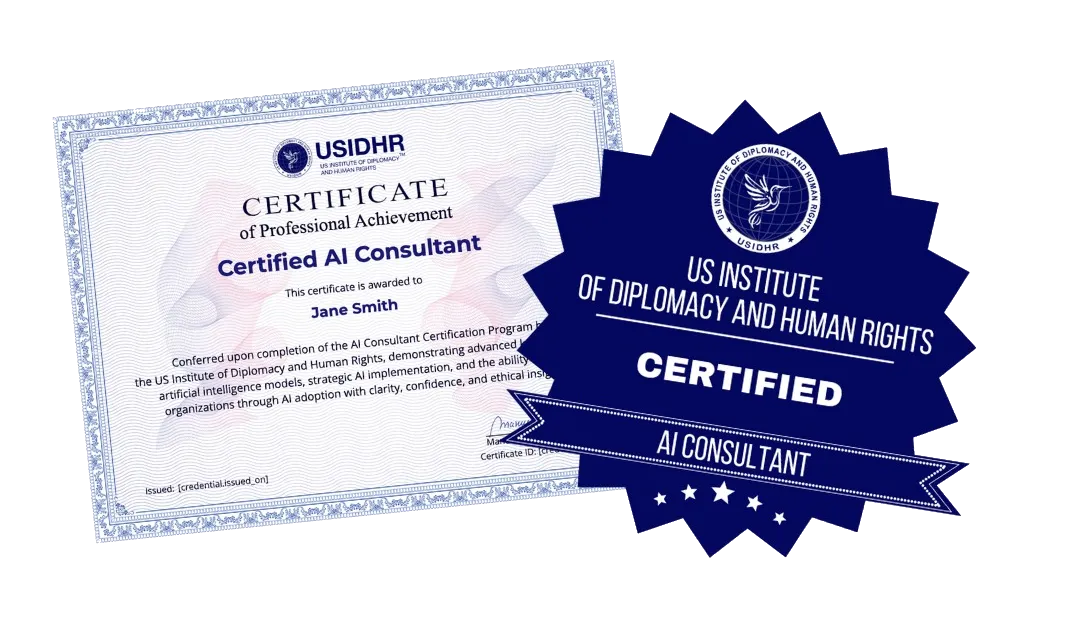
USIDHR Pathways
Advanced certification opportunities
Professional ID cards and credentials
Ongoing consulting guidelines and support
Alumni network and continuing education
Resource Library: Downloadable templates, assessment tools, glossary, and reference materials
YOU WILL GRADUATE WITH
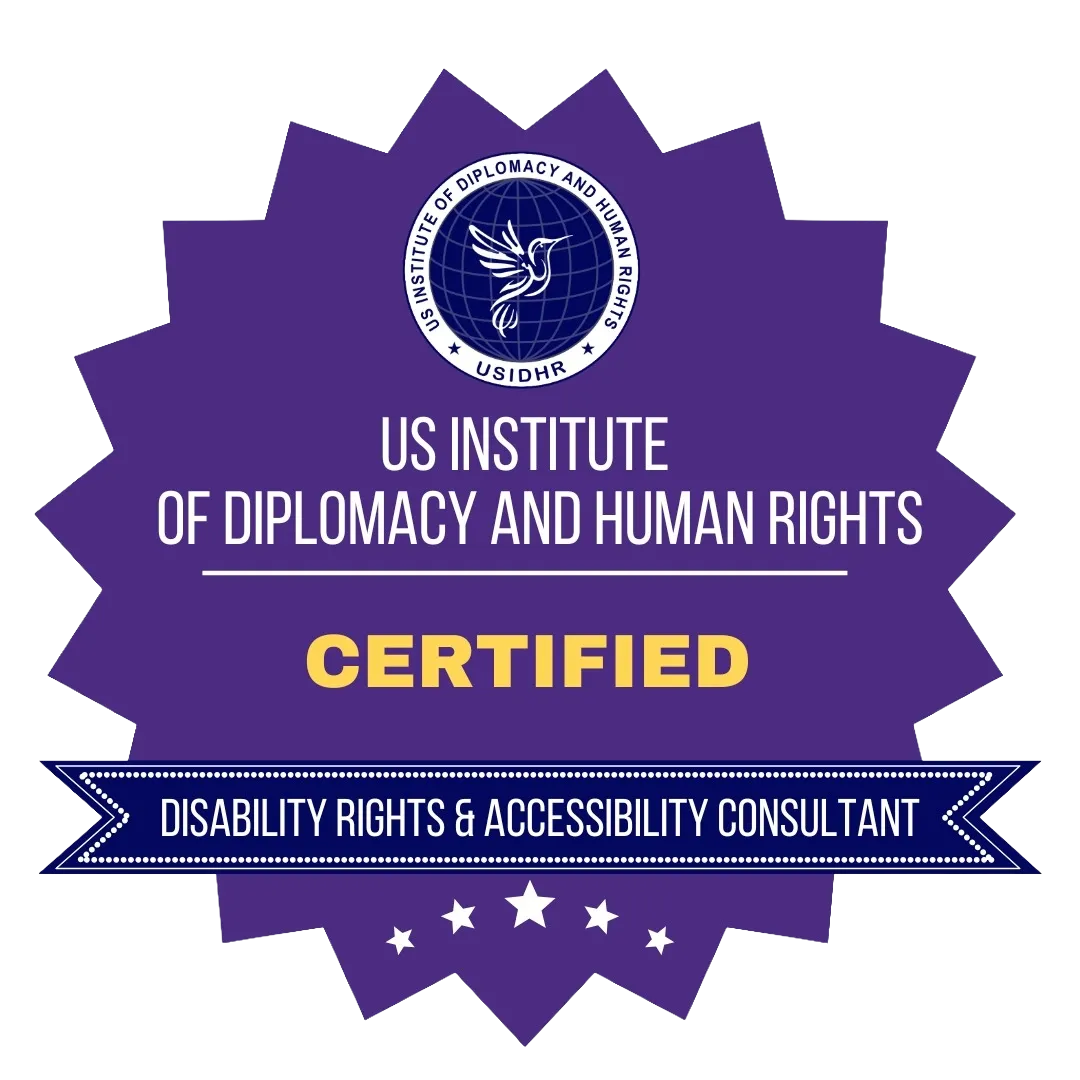
Disability Rights & Accessibility Consultant Certification
A complete, portfolio-ready consulting project
Access to a global network of certified consultants
Professional templates for assessments, education sessions, and consultations
Scripts, checklists, and frameworks for delivering expert guidance
Confidence to advise organizations with clarity, professionalism, and global best practices
WHO SHOULD APPLY

Aspiring consultants specializing in disability rights and accessibility
Social workers, case managers, and human services professionals
Compliance officers, trainers, educators, and policy professionals
Business owners, nonprofit leaders, and program directors
Freelancers, trainers, and service providers expanding into accessibility consulting
Career professionals looking to upskill and enter a growing global field
Professionals who work directly with people with disabilities, including support coordinators, disability advocates, rehabilitation specialists, and community program staff
Anyone committed to strengthening accessibility and improving disability rights worldwide
USIDHR Pathways
Advanced certification opportunities
Professional ID cards and credentials
Ongoing consulting guidelines and support
Alumni network and continuing education
Resource Library: Downloadable templates, assessment tools, glossary, and reference materials
Why Get Certified with the US Institute of Diplomacy and Human Rights?
The US Institute of Diplomacy and Human Rights (USIDHR) is a think tank based in Washington, DC.
Our mission is to advance education for all and provide solutions to enhance global understanding through research, training and programs.
For each course you take with USIDHR you are in fact making a donation to help vulnerable children around the world don't miss out on quality education.
Through our charitable program, Edu for Every Child, we support 258 million children by providing them with much-needed resources to go to school.
We believe each child deserves access to quality education. We provide them with the Edu-boxes that contain uniforms, shoes, backpack, school supplies and all necessities to go to school for an entire year.
USE THESE QUESTIONS WHEN REVIEWING ORGANIZATIONAL INCLUSION
Disability + Race/Ethnicity:
- Bullet List 1
- Bullet List 2
- Bullet List 3
- Bullet List 4
- Bullet List 5
BECOME A CERTIFIED DISABILITY RIGHTS & ACCESSIBILITY CONSULTANT

The US Institute of Diplomacy and Human Rights (USIDHR) is an International Continuing Professional Development (CPD) Accredited Organization. Accredited CPD training means the learning activity has reached the required Continuing Professional Development standards and benchmarks. The learning value has been scrutinized to ensure integrity and quality. The CPD Certification Service provides recognized independent CPD accreditation compatible with global CPD requirements.
LIMITED SPOTS AVAILABLE
LIMITED ENROLLMENT NOW OPEN
Enrollment is limited to maintain an exceptional learning experience and preserve the prestige of this international certification.
Once the cohort reaches capacity, registration closes.
Duration: 8 Weeks (Flexible Weekly Format)
Format: 100% Online & Self-paced
Certificate: Yes
Access: Lifetime

Total Value
$2997

Today Only
$497
Frequently Asked Questions (FAQ)
What does the Disability Rights & Accessibility Consultant Certification cover?
The certification provides a comprehensive understanding of disability rights, global accessibility standards, universal design principles, accommodation practices, consulting methodologies, ethical guidelines, and practical tools for supporting accessible environments across organizations worldwide.
Who is this course suitable for?
This training is designed for aspiring consultants, social workers, educators, professionals who work directly with people with disabilities, compliance officers, nonprofit leaders, human services providers, rehabilitation and support specialists, and anyone seeking to develop expertise in disability rights and accessibility.
Do I receive a certificate upon completion?
Yes. After completing the program requirements and final project, you will receive an internationally recognized Disability Rights & Accessibility Consultant Certification issued by the US Institute of Diplomacy and Human Rights (USIDHR), an accredited CPD organization.
How long is the course, and is it flexible?
The program is eight weeks in length and fully self-paced. You can complete each module on your own schedule, with the flexibility to learn at a pace that fits your professional and personal commitments.
What support and resources are included?
You receive lifetime access to all training content, downloadable toolkits, templates, consulting frameworks, and a series of exclusive expert interviews. You will also receive personalized feedback on your final project to help refine your consulting skills.
Do I need prior legal or technical knowledge?
No. The program is designed for learners of all backgrounds. The curriculum breaks down every concept step-by-step in clear, practical language. No legal or technical experience is required.
Can I work as a consultant professionally after certification?
Yes. The certification prepares you with the knowledge, frameworks, and practical tools required to advise organizations on disability rights and accessibility. Many graduates use this training to enhance their current role or transition into professional consulting in the field.
TESTIMONIALS
Maria S.
HR & Compliance Manager
helped me step into leadership
This certification completely transformed the way I support inclusion in my organization. The modules made disability rights and accessibility easy to understand, even without a legal background. Within weeks, I led my first accessibility review something I never imagined doing confidently. The training, the tools, and the ongoing support gave me the structure I needed to show up as a true accessibility advocate

Jordan M.
Compliance Coordinator, UK
gave me the clarity I needed
This certification is practical, structured, and incredibly effective. It gave me the exact guidance I needed to begin supporting organizations with disability rights and accessibility work
Noah K.
Independent Accessibility Consultant
I felt fully prepared
After completing the certification, I felt fully prepared to support organizations with real accessibility needs. I led two successful assessments within my first month something I never would’ve attempted before this training
Leena A.
Community Outreach Specialist
USIDHR made it simple
It gave me a clear, step-by-step roadmap to understand disability rights and accessibility even without a legal background. I used to feel unsure about giving guidance, but this program explained everything in a way that actually clicked. Now I’m supporting two organizations with their inclusion initiatives and finally doing work that feels meaningful and impactful.
Noah K.
Independent Accessibility Consultant
Independent Accessibility Consultant
I felt fully prepared After completing the certification, I felt fully prepared to support organizations with real accessibility needs. I led two successful assessments within my first month something I never would’ve attempted before this training

EARNINGS DISCLAIMER: We don't believe in "get rich" programs - only in hard work, adding value, building a real and professional career, and serving others with excellence and consistency. Our trainings are intended to help you share your message with a wider audience and to make a difference in the world while growing your personal brand. Our programs take a lot of work and discipline just like any worthwhile endeavor or professional continuing education program. As stipulated by law, we cannot and do not make any guarantees about your ability to get results or earn any money with our ideas, information, tools or strategies. We don't know you and, besides, your results in life are up to you. Agreed? We just want to help by giving great content, direction, and strategies. You should know that all products and services by our company are for educational and informational purposes only. Nothing on this page, any of our websites, or any of our content or curriculum is a promise or guarantee of results or future earnings, and we do not offer any legal, medical, tax or other professional advice.